
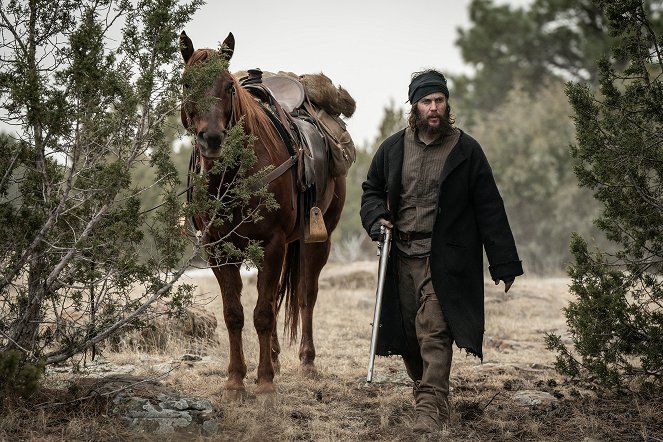
Been a minute, but I’m back. I would’ve written something sooner, but these pills I’m taking to quit nicotine keep making me nauseous. Anyway.
In a time with no monoculture, where no one is watching the same things, it can be hard to tell what shows are connecting with people. However, only three things are inevitable in society today: death, taxes, and Netflix. Seeing as American Primeval hit number one on Netflix last week, I figure enough people have seen it—or at least heard of it—that I can write about it and somebody somewhere will give a shit.
But that leads to another interesting question about what exactly it is I’m trying to accomplish with this (I hate the following word) blog. In theory, I want to talk about shows in the hopes that you, dear reader, will watch them. On the other hand, I don’t want to be hamstrung by not being able to spoil these shows, because there’s stuff I want to talk about that ranges from light spoilers to “end of The Sixth Sense” level spoilers. I think I may have found a solution to this. It might end up being a dumb solution, but we’re going to go with it. Towards the end of this post, I’m going to do a big spoiler warning, and after that, you can proceed at your own risk. Got it? Cool.
I expected very little from this show, and that’s my fault. I’ve been so distracted by Severance coming back that I haven’t focused on much else. Turns out, American Primeval is metal as all get out. While this show’s creator, Mark L. Smith, might not be a household name, he does have one particular credit to his name that should have put us all on high alert for this show. That’s right—this Mark L. Smith guy co-wrote one of the best movies of the 2010s, The Revenant, with Alejandro G. Iñárritu. (By the way, if you like The Revenant as much as I do, there are like three dudes in this show giving off the same vibes as Tom Hardy in that movie.) His new project feels like a return to the same mood of the 2015 film, inverting the view of the 19th-century American West, painting it as a place of physical hardship, and sucking out all of the romantic beauty we have become accustomed to when seeing it on our screens.
American Primeval toes this line perfectly. Shot on location in New Mexico, we are given classic Western vistas, from gorgeous plains to harsh mountains, only this time the color palette is drawn away from brilliant golds and greens toward dull browns and grays. One of the recurring locations is Fort Bridger, an oasis for lowlifes and cutthroats, which is shown to merely be a pile of sticks on a bed of mud. Nothing in this world is clean, and while some of it may be beautiful in its scale or majesty, none of it is pretty. Peter Berg, who directed the entirety of the series, gives us this unvarnished look at the West while employing his signature, steady-cam-heavy style. Berg is a fantastic match for Smith’s script, bringing us up close and personal with the West’s harsh realities, never letting the viewer turn a blind eye to the brutal lives led by our characters.
Now that I’ve gotten all that artsy stuff out of my system, let’s get back to my main point: this show is hardcore. It’s been a long time since I’ve seen a show this brutally violent. American Primeval is set in 1857 around the Mountain Meadows Massacre, in which a Mormon militia brutally murdered approximately 120 people. I know what you’re thinking, and yes, they show the massacre, and yes, it’s incredibly gory. If you don’t like blood and guts on screen, I don’t blame you, but this show probably isn’t for you. This show doesn’t shy away from violence in any form; people get their heads bashed in, throats slit, scalped, surgery to fix that scalping, and some far less savory things that I would feel yucky even typing on here. And they show almost all of it. Sometimes horrifying, sometimes just plain gross, but we see some shit on this show.
To many, this may seem gratuitous, but it gets at an underlying theme that I think drives this show home: this land does not want you. Our main protagonist is Sarah, played wonderfully by a personal favorite of mine, Betty Gilpin, who is traveling across the West with her son to reach her husband. As she makes her journey, she naturally faces some challenges and setbacks, forcing her to ask if she is capable of making this voyage across a country that is seemingly rejecting her—a struggle strongly mirrored by her lingering fear that her husband will reject her upon her arrival. Maybe she shouldn’t have come West in the first place.
Gilpin headlines a cast that is full to the brim with TV all-stars, including Kim Coates, Shea Whigham, and Joe Tippett. There are a few cast members in particular who put up performances worthy of being singled out, including a personal favorite, my boy Dane DeHaan. His character, Jacob, doesn’t always work for me, but the performance is fantastic, playing jump rope with the line between mercy and madness. DeHaan has been magnetic on screen for over ten years, and he continues that run here.
Playing opposite DeHaan is Saura Lightfoot-Leon as Jacob’s wife, Abish, and she looks to me like a rising star. Lightfoot-Leon is certainly having a moment right now, with American Primeval and The Agency airing concurrently, and she is dazzling and undeniable in both. Her power on screen is startling for an actor as new to the business as she is, bringing an air of “there’s more behind her eyes” to scenes of both high and low energy. I fear I might be jumping the gun by crowning her a star of tomorrow, but in the past two months I have seen her display acting chops that are tough to come by. Definitely a performer to keep an eye on.
At the center of this show is Taylor Kitsch’s character, Isaac. I have waited what feels like millennia to have Kitsch back in my life in a meaningful way, and I know I’m not the only one. After the end of Friday Night Lights, it felt like Kitsch had a chance to be an A-lister. He brought a depth to the character of Tim Riggins, which in lesser hands would have been just another jock on a teen show. I had to sit idly by while Kitsch was wasted in project after project (I even got my hopes up for his role in the second season of True Detective), but now I finally get to see the return of his unparalleled skill at playing a tortured badass. He brings a sullen pain to this role that is not easily replicated, drawing the viewer in while simultaneously keeping them at arm’s length. Performances like this one make viewers clamor for more of a character’s backstory, and this one is no exception. American Primeval’s cast is fantastic across the board, but it is the offbeat performance of Kitsch—one that makes you lean in when every fiber of you says lean back—that carries the heart of this story.
If you read this and want to watch the show, first of all, thanks. It means a lot that you’re taking my TV advice. Most people don’t. Second of all, happy hunting. American Primeval is definitely not for everyone. It’s rarely pretty and often horrifying, but it’s buoyed by performances and direction that are rare to find in our dystopian streaming era. This is by no means a perfect show, but it is certainly metal. If your goal is to avoid spoilers, this is where I leave you, but maybe you can come back and read the rest of this after watching the show.
*** SPOILER ALERT FOR ALL OF AMERICAN PRIMEVAL ***
Now I can get into the nitty-gritty. For those of you who have seen the show, or just don’t care and want to hear what I have to say, I’ll catch you up. Reluctantly, Kitsch’s Isaac helps Gilpin’s Sarah and her son traverse the dangers of the West. During their journey, Isaac and Sarah fall for each other, and in the end, Isaac dies protecting them. Meanwhile, Lightfoot-Leon’s Abish is taken in by the Shoshone tribe, and DeHaan’s Jacob fruitlessly tries to rescue her. In a raid on the Shoshone, Jacob unwittingly kills Abish and then takes his own life. Now you’re caught up.
Both of these plotlines feel narratively fulfilling and, at points, even poetic. Jacob’s mad search for his wife leads to her death—what a twist! Isaac didn’t care about anybody, but then he met a nice lady and her son, and he learned to open up. Good for him! Stories like this feel obvious and tropey for a reason: they work, and they always have. No new ground is being broken here, and that’s just fine with me. American Primeval feels in many ways like a lesson to me, which is why I opted to write about this show and not The Pitt. The lesson is simple: love the one you’re with. This story is allowed to feel obvious and simple because it does not attempt to be anything else. Berg and Smith have taken a genre and a story that has been told over and over, and they have put their spin on it. That’s great.
Therein lies the question. I truly enjoyed this show. American Primeval set out to deliver a very expensive, blood-soaked, earth-toned, simple story—and it nailed that. I also learned a lot about the Utah War, and learning is great. However, upon finishing this series, one glaring question clouded my mind: so what? What is this show trying to say? Is there some deeper meaning so profound and complex that my tiny brain just can’t grasp it? Most importantly, does this show have a responsibility to say something more?
And that, dear reader, is the problem with this series I’ve been wrestling with. It tells a story that feels familiar but doesn’t offer any new ideas. Opening your heart, keeping an open mind to other cultures, and defending what you love with your life are great messages, but they don’t feel novel or groundbreaking in any way. Shows like this are fertile ground to Trojan horse an idea into the text. Especially from a series with two brilliant creatives behind it, one might expect something profound to chew on afterward. Instead, we are left with an “I liked the scene where Tim Riggins killed those guys” type of show.
But maybe that’s okay. Maybe I can enjoy this show for what it is trying to do and not for what it seemingly has no interest in. It feels unfair to grade harshly based on missed opportunities. It’s more appropriate to evaluate it based on misfires, of which this show has few. I’ve chosen to meet this show where it is, to use my microscope to study what it puts forth, not the vacuum surrounding it. I enjoyed American Primeval for what it is, and while I thank you for reading my thoughts on what it’s not, they shouldn’t detract from the series itself. So, if your interest has been piqued by anything I’ve said here, give American Primeval a whirl, and remember: love the one you’re with.
Give this show a shot if you like:
- Westerns
- Blind, hateful violence
- Tim Riggins
- Familiar stories told in new ways
- The Revenant
- People who aren’t Tom Hardy but are totally Tom Hardy
- Dunking on the Mormons
 joe-tv.com